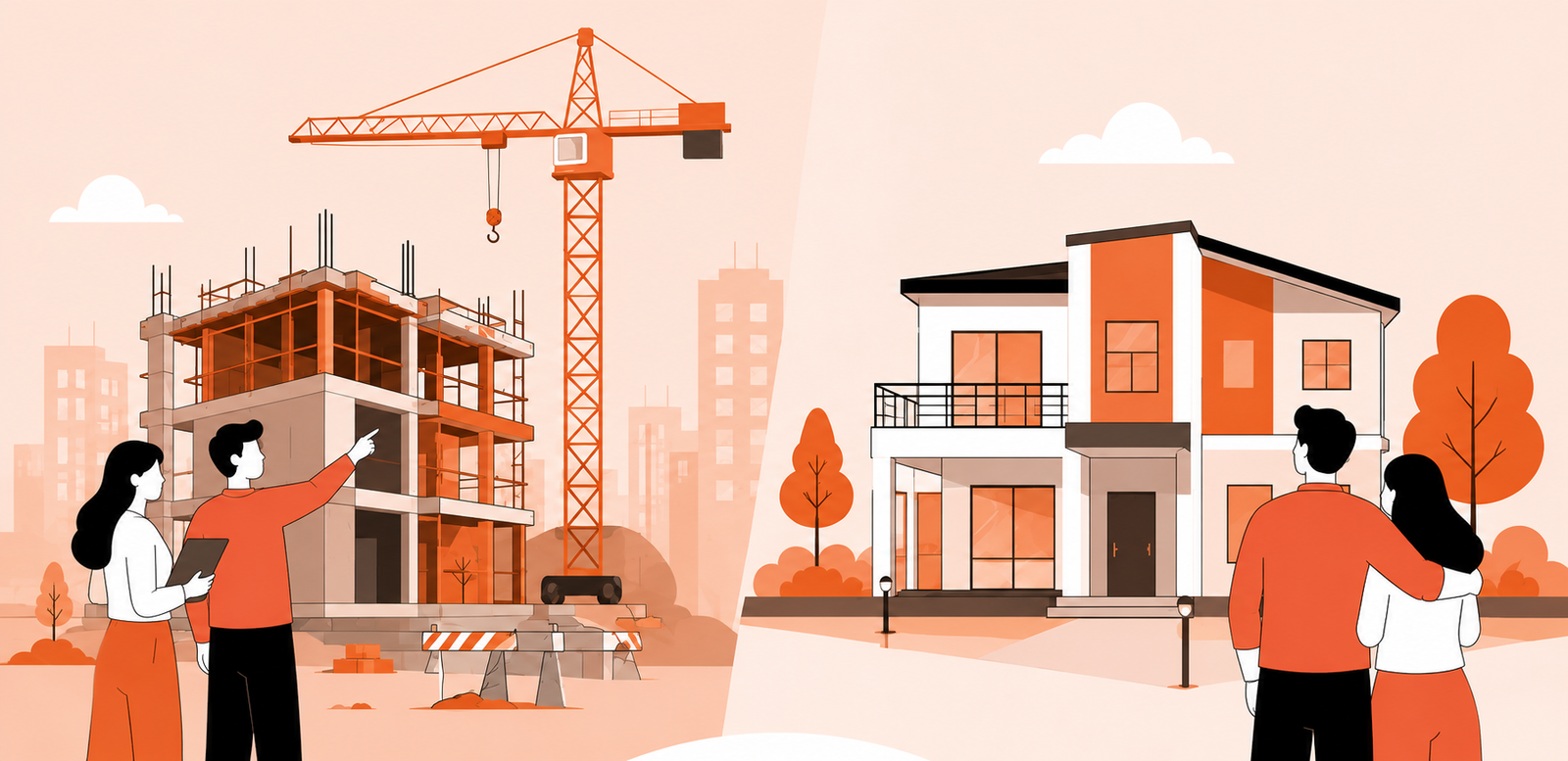


Buying a home is one of the most important financial decisions in a person’s life. However, before investing in real estate, buyers often face a common question: Ready-to-Move vs Under-Construction Property: Which Is Better? Both options have advantages and disadvantages, depending on your budget, financial goals, lifestyle, and investment horizon.
A ready-to-move property allows you to occupy your home almost immediately, while an under-construction property may offer a lower initial purchase price, flexible payment schedules, and potential appreciation during development. However, factors such as construction delays, additional costs, property taxes, and developer reliability must be considered before making a decision.
In this guide, we will compare ready-to-move and under-construction properties in India to help you choose the right option for your needs.
What Is a Ready-to-Move Property?
A ready-to-move property is a residential apartment, flat, or house where construction has been completed and the required completion or occupancy approvals have been obtained, as applicable. The property is available for possession, subject to the seller completing the necessary legal and transaction formalities.
Buyers can inspect the actual property, evaluate its construction quality, check the available amenities, and understand the surrounding neighbourhood before making a purchase.
Advantages of Ready-to-Move Property
1. Immediate Possession
One of the biggest advantages of a ready-to-move home is that you do not have to wait for construction to finish. Once the transaction is completed and possession is legally available, you can move into the property.
This option is particularly useful for families who need a permanent residence quickly or buyers relocating for work.
2. No Construction Delay Risk
Since construction is already complete, buyers do not have to depend on the developer to finish the building in the future. This reduces the risk of delays caused by labour shortages, funding problems, approval issues, or material costs.
However, buyers should still verify the property’s completion documents and occupancy status.
3. No GST on Qualifying Completed Properties
Under India’s GST framework, the sale of a completed building is generally outside GST when the entire consideration is received after the required completion certificate or first occupation, whichever is earlier. Buyers should verify the property’s legal status and transaction structure before assuming that GST does not apply.
Stamp duty, registration charges, and other applicable transaction costs may still be payable.
4. Opportunity to Inspect the Actual Property
Buyers can examine the flat’s layout, ventilation, natural light, fittings, water supply, lifts, parking, security, and common facilities.
They can also assess the condition of the building and identify visible defects before finalising the purchase.
5. Easier Financial Planning
Ready-to-move properties generally involve a more predictable purchase timeline. Buyers can plan their home loan, down payment, interior work, moving expenses, and monthly household budget with greater certainty.
If the property is being purchased with a home loan, the EMI typically begins according to the lender’s disbursement and repayment terms.
Disadvantages of Ready-to-Move Property
Despite its advantages, a ready-to-move property may not suit every buyer.
- Higher purchase price: Established properties in desirable locations may cost more than comparable units in newly launched projects.
- Limited customisation: Changing the layout, plumbing, electrical systems, or structural features may be difficult or expensive.
- Older construction: Some resale properties may require repairs, renovation, or replacement of fittings.
- Limited inventory: Buyers may have fewer options for floor selection, views, layouts, or amenities in a completed project.
- Maintenance concerns: Older buildings may have higher maintenance requirements or upcoming major repairs.
Before purchasing a resale flat, check the ownership documents, outstanding dues, building maintenance records, and any pending legal disputes.
What Is an Under-Construction Property?
An under-construction property is a residential unit or building that is still being developed. Buyers purchase the property before construction is fully completed, often based on the approved plans, sample flat, project specifications, and developer’s commitments.
These properties are commonly offered in newly launched or ongoing residential projects.
Advantages of Under-Construction Property
1. Potentially Lower Entry Price
Developers may offer launch-stage prices or payment incentives to attract buyers. As a result, an under-construction apartment may cost less than a comparable ready-to-move unit in the same locality.
However, this is not guaranteed. The final price depends on the developer, location, project stage, demand, and prevailing market conditions.
2. Flexible Payment Plans
Many developers link payments to construction milestones or offer other payment schedules. This may allow buyers to spread their financial commitment over the construction period.
The exact payment plan should be examined carefully. Buyers must understand the booking amount, instalment dates, interest or penalty provisions, and cancellation conditions.
3. Modern Amenities and Design
New residential projects may offer contemporary layouts, energy-efficient features, landscaped gardens, fitness facilities, children’s play areas, and modern security systems.
These facilities can improve convenience and may increase the property’s appeal to future buyers or tenants.
4. Potential Capital Appreciation
If the locality develops, infrastructure improves, and housing demand increases, the property’s market value may rise before possession.
Nevertheless, appreciation is never guaranteed. Prices can remain unchanged or fall because of oversupply, weaker demand, economic conditions, or project-specific problems.
5. More Choices During Early Construction
Purchasing at an early stage may provide a wider selection of floors, views, layouts, or unit sizes, depending on availability.
Buyers should ensure that the selected unit and its specifications are clearly documented in the agreement.
Disadvantages of Under-Construction Property
1. Risk of Construction Delays
Possession may be delayed because of funding difficulties, contractor problems, regulatory approvals, litigation, or other unforeseen circumstances.
A delayed project can disrupt family plans and create additional rental and financing expenses.
2. Uncertainty About the Final Product
The actual property may differ in appearance or finishing from the sample flat or marketing materials. Buyers should review the approved plans, specifications, agreement, and legally binding commitments rather than relying only on promotional representations.
3. Additional Financial Burden
Depending on the payment schedule and home loan, buyers may need to manage pre-EMI interest, rent, instalments, and other expenses simultaneously.
Some buyers may also face changes in their financial circumstances before possession.
4. Developer and Project Risk
A developer’s financial difficulties, legal disputes, or failure to meet contractual obligations may affect the construction timeline and delivery.
Checking project registration, approvals, litigation disclosures, and construction progress is therefore essential.
5. GST and Other Costs
Under-construction residential properties are generally subject to applicable GST rules. For qualifying residential construction services under the current rate structure, the commonly applicable effective rates are 1% for affordable residential apartments and 5% for other residential apartments, without input tax credit, subject to the relevant conditions.
The actual tax treatment depends on the transaction and applicable rules. Buyers should confirm the applicable rate with the developer and a qualified tax professional.
Ready-to-Move vs Under-Construction Property: Key Differences
| Comparison factor | Ready-to-move property | Under-construction property |
| Possession | Usually available sooner | Requires completion and handover |
| Initial price | May be higher | May offer a lower entry price |
| Construction delay risk | Generally low | Higher |
| Physical inspection | Actual unit can be inspected | Buyers rely partly on plans and specifications |
| GST | Generally not applicable to qualifying completed-property sales | Generally applicable under relevant GST rules |
| Payment schedule | Often concentrated around purchase and registration | May be linked to construction milestones |
| Rental income | May begin sooner if the property is suitable and legally available | Usually begins after possession and tenant preparation |
| Customisation | Often more limited | Some choices may be available during construction |
| Investment horizon | Suitable for immediate use or income | Often better suited to buyers able to wait |
| Main concern | Price, age, condition, and title | Delivery, developer reliability, and final cost |
The better option depends on your financial position, expected possession date, and the purpose of buying the property.
Which Property Is Better for Investment?
Real estate investors should evaluate rental potential, capital appreciation, location, liquidity, and total ownership cost before choosing a property.
Ready-to-Move Property for Investment
A ready-to-move property can be attractive to investors who want to generate rental income relatively quickly. The actual location, building, and apartment can be inspected, and local rental demand can be assessed before purchase.
For example, a flat near an employment hub, university, hospital, or transport corridor may attract tenants if the rent is competitive and the property is well maintained.
Investors should calculate the expected rental yield rather than relying only on the property’s advertised price.
Rental yield formula:
Gross rental yield = (Annual rental income ÷ Total property purchase price) × 100
For a more realistic estimate, deduct maintenance charges, property management expenses, vacancy periods, repairs, and other applicable costs.
Under-Construction Property for Investment
An under-construction property may suit investors who can wait for possession and are comfortable with construction-related risks.
The investment case may be stronger when the project is located in a developing area with credible infrastructure plans, sustainable housing demand, and a reliable developer.
However, future appreciation should not be assumed. A lower booking price does not automatically mean a better investment if possession is delayed or resale demand is weak.
Before investing, compare the expected future value with the total purchase cost, taxes, financing expenses, and opportunity cost of the money invested.
Which Is Better for First-Time Homebuyers?
For first-time homebuyers, the decision should be based on affordability, living requirements, income stability, and risk tolerance.
A ready-to-move home may be more appropriate if you need to relocate soon, are currently paying rent, or prefer to inspect the exact property before committing your savings.
An under-construction home may be worth considering if you have a stable income, do not need immediate possession, and have thoroughly checked the developer and project documentation.
First-time buyers should avoid stretching their budget simply because a developer offers a lower booking amount. The complete cost of ownership is more important than the initial payment.
A practical budget should include:
- Down payment and home loan expenses
- Stamp duty and registration charges
- Applicable GST, if any
- Interior work, furniture, and appliances
- Moving expenses and initial repairs
- Monthly maintenance and utility costs
- An emergency fund for unexpected expenses
Which Property Is Better for Home Loan Buyers?
Both ready-to-move and under-construction properties can be financed through home loans, subject to lender eligibility, project approval, and other conditions.
However, the disbursement and repayment arrangements may differ.
Home Loan for Ready-to-Move Property
For a completed property, the lender generally assesses the buyer’s income, credit profile, property valuation, title documents, and applicable approvals.
The loan may be disbursed according to the transaction and lender’s requirements. The EMI and repayment schedule should be confirmed before signing the loan agreement.
Home Loan for Under-Construction Property
For an under-construction property, loan disbursement may occur in stages based on construction progress and the lender’s conditions.
During the disbursement period, some borrowers may pay pre-EMI interest on the amount disbursed, while others may follow a different repayment arrangement. The precise terms depend on the loan agreement.
Buyers should calculate whether they can afford rent, loan payments, and other household expenses if construction takes longer than expected.
Never choose a property solely because the monthly instalment initially appears affordable.
GST on Ready-to-Move vs Under-Construction Property
GST is an important consideration when comparing the two options in India.
A qualifying sale of a completed property is generally not subject to GST when the entire consideration is received after the required completion certificate or first occupation, whichever is earlier.
An under-construction residential apartment sold before the relevant completion or first-occupation milestone is generally treated differently for GST purposes.
Under the applicable concessional rate framework, the commonly used effective rates for qualifying residential apartments are:
- 1% GST: Affordable residential apartments meeting the applicable definition and conditions.
- 5% GST: Other qualifying residential apartments.
These rates are subject to the applicable legal conditions, and the treatment of a particular transaction should be confirmed before purchase.
Buyers should request a written cost breakdown from the developer. It should distinguish the base price, GST, parking or other charges where applicable, maintenance deposits, stamp duty, registration charges, and any other amounts payable.
Do not compare the advertised prices of two properties without checking whether both quotations include the same categories of expenses.
RERA Rules and Legal Checks Before Buying Property
India’s Real Estate (Regulation and Development) Act, 2016, commonly known as RERA, provides a regulatory framework for eligible real estate projects and promotes transparency and accountability.
Before buying an under-construction property, verify the project’s registration with the relevant state or union territory RERA authority, where registration is required. Review the registered completion timeline, approved plans, disclosures, and available project updates.
For ready-to-move properties, verify the completion and occupancy documents required for the building, along with the title and transaction records.
Important Documents to Check
- Title documents: Confirm that the seller has the legal right to sell the property and investigate any title disputes or encumbrances.
- RERA registration: Verify the project’s registration and disclosures where applicable.
- Approved building plans: Check that the construction and unit details align with the approved plans.
- Completion certificate: Verify the relevant completion documentation issued by the competent authority.
- Occupancy certificate: Confirm that the building has the required approval for occupation, where applicable.
- Sale agreement: Review the payment schedule, possession date, specifications, cancellation provisions, and delay-related clauses.
- Encumbrance and loan status: Check for mortgages, charges, and other claims affecting the property.
- Tax and maintenance dues: Confirm that applicable property taxes, utility bills, and society dues are paid or properly accounted for.
If you are buying a property in Rajasthan, you can use the official Rajasthan RERA website to search for registered projects and review available disclosures.
For either property type, consider having a property lawyer review the documents before paying a substantial amount or signing the agreement.
Ready-to-Move vs Under-Construction Property: Cost Comparison
The purchase price alone does not determine which property offers better value. Buyers should compare the total cost of acquiring, financing, maintaining, and eventually selling the property.
Consider the following hypothetical example.
| Cost component | Ready-to-move property | Under-construction property |
| Base property price | ₹75 lakh | ₹68 lakh |
| Illustrative GST | ₹0, assuming a qualifying completed-property sale | ₹3.40 lakh, assuming a 5% applicable rate on the full stated base price |
| Stamp duty and registration | Additional | Additional |
| Interiors and furnishing | Additional | Additional |
| Financing and waiting costs | Depends on loan and possession | Depends on disbursement, rent, and construction timeline |
In this simplified example, the under-construction property has an initial price advantage of ₹7 lakh. However, adding the illustrative GST of ₹3.40 lakh reduces the difference to ₹3.60 lakh before considering other costs.
This is not a quotation or a universal tax calculation. Actual GST valuation, exemptions, applicable rates, stamp duty, and registration charges depend on the transaction and local rules.
If the buyer must continue paying rent during construction, the remaining price difference may become smaller or disappear. Conversely, a well-priced project with a reliable delivery schedule may still offer good value.
The correct approach is to compare the complete financial commitment for both properties.
Is Under-Construction Property Riskier Than Ready-to-Move Property?
Generally, under-construction property involves more uncertainty because buyers commit money before the final building is available for inspection and occupation.
The most important risks include:
- Construction or possession delays
- Developer financial difficulties
- Changes in the local property market
- Differences between promised and delivered specifications
- Disputes involving approvals, title, or contractual obligations
Ready-to-move property reduces construction-related uncertainty, but it is not risk-free. Legal disputes, unauthorised alterations, structural defects, poor maintenance, and inaccurate ownership records can still create serious problems.
Therefore, buyers should not assume that a completed property is automatically safe or that every under-construction project is risky. Proper due diligence is essential in both cases.
How to Choose the Right Location
Location can influence both a property’s daily usability and its long-term investment performance.
Before choosing either type of property, assess:
Connectivity: Consider access to public transport, main roads, railway stations, and other important routes.
Employment opportunities: Nearby business districts, industrial areas, hospitals, and educational institutions may influence housing demand.
Infrastructure development: Evaluate existing roads, water supply, electricity, drainage, and other essential facilities. Treat proposed infrastructure as uncertain until its status and timeline are verified.
Social amenities: Check access to schools, healthcare, shops, parks, and other facilities that matter to your household.
Neighbourhood quality: Visit the area at different times to assess traffic, noise, safety, waterlogging, and general maintenance.
Resale and rental demand: Research comparable properties, actual transaction prices where available, prevailing rents, and vacancy levels.
A good location can support a property’s appeal, but no location guarantees appreciation or rental income.
Common Mistakes to Avoid When Buying Property
Whether you choose a ready-to-move or under-construction property, avoid these common mistakes.
1. Comparing Only the Base Price
A lower advertised price may exclude taxes, registration, parking, interiors, or other charges. Compare the complete cost of both options.
2. Ignoring the Possession Timeline
Do not rely solely on verbal assurances. Check the contractual possession date, applicable extension provisions, and remedies for delay.
3. Skipping Legal Verification
A property may look attractive but still have title problems, unauthorised construction, or missing approvals. Have the documents independently reviewed.
4. Depending Entirely on Future Appreciation
Property prices can rise or fall. Evaluate affordability and the property’s present-day usefulness instead of relying on optimistic forecasts.
5. Underestimating Maintenance Costs
New buildings can have maintenance expenses, while older properties may require repairs to lifts, plumbing, electrical systems, or common areas.
6. Ignoring Resale Liquidity
Consider how easily the property could be sold if your employment, family, or financial circumstances change.
7. Using All Available Savings
Maintain an emergency reserve after paying the down payment and transaction costs. Unexpected expenses can arise during construction, moving, or homeownership.
Ready-to-Move vs Under-Construction Property: Which Should You Choose?
Your best choice depends on your priorities.
Choose a ready-to-move property if:
- You need a home immediately or within a short period.
- You want to inspect the actual flat before purchasing.
- You prefer lower construction-related uncertainty.
- You want to explore rental income without waiting for construction.
- You can afford the total purchase price and associated costs.
Choose an under-construction property if:
- You can wait until the project is completed.
- The price and payment plan fit your financial position.
- You have verified the developer’s track record and project registration.
- You can manage rent and financing costs during construction.
- You understand the risks and are not depending on guaranteed appreciation.
Neither option is universally better. A completed property with legal or structural issues may be a poor purchase, while an under-construction property from a reliable developer may be suitable for a buyer with a longer timeline.
Frequently Asked Questions (FAQs)
1. Which is better, ready-to-move or under-construction property?
Ready-to-move property is generally more suitable for buyers who need immediate possession and want to inspect the actual home. Under-construction property may suit buyers who can wait and find a suitable project at a competitive total cost.
2. Is ready-to-move property cheaper than under-construction property?
Not necessarily. Ready-to-move homes may have higher base prices in established locations, while under-construction homes may have lower entry prices. Taxes, rent, financing costs, and other charges can change the final comparison.
3. Is GST applicable to ready-to-move flats in India?
GST is generally not applicable to a qualifying completed-property sale when the entire consideration is received after the required completion certificate or first occupation, whichever is earlier. The precise transaction must meet the applicable conditions.
4. What is the GST rate on under-construction property?
Under the applicable concessional framework, qualifying affordable residential apartments commonly attract 1% GST and other qualifying residential apartments commonly attract 5%, without input tax credit. Specific conditions and exceptions apply, so buyers should confirm the current treatment for their transaction.
5. Can I get a home loan for an under-construction property?
Yes. Banks and other eligible lenders may finance under-construction properties, subject to the buyer’s eligibility, project approval, documentation, and loan terms.
6. Is under-construction property a good investment?
It can be suitable for investors who can tolerate construction delays and market uncertainty. The investment should be assessed using the total acquisition cost, realistic appreciation assumptions, expected rental demand, and developer reliability.
7. What documents should I check before buying a flat?
Check title documents, the sale agreement, approved plans, applicable RERA disclosures, completion and occupancy certificates where required, and details of outstanding loans, dues, and encumbrances.
8. Can an under-construction property be sold before possession?
Resale or transfer may be possible, but it depends on the agreement, applicable law, project conditions, lender requirements, and any charges or permissions that apply. Review these terms before purchasing.
9. Does ready-to-move property offer better rental returns?
It may allow rental income to begin sooner, provided the property is suitable and tenants are available. Actual returns depend on purchase price, location, rent, vacancy, maintenance, and other expenses.
10. Should first-time buyers prefer ready-to-move homes?
First-time buyers who need certainty about the actual property and possession may prefer ready-to-move homes. Buyers with a longer timeline may consider under-construction projects after carefully checking affordability, documentation, and developer reliability.
Conclusion
Choosing between a ready-to-move and an under-construction property requires more than comparing two prices. Buyers must consider possession timelines, total costs, legal documentation, construction risks, financing, location, and long-term goals.
A ready-to-move property can be the better choice for buyers who value immediate use, visibility into the actual property, and reduced construction uncertainty. An under-construction property may offer attractive pricing, payment flexibility, and potential appreciation for buyers who can wait and carefully assess the risks.
Before making a final decision, compare at least a few properties in the same locality, calculate the complete cost of ownership, verify all relevant documents, and seek independent legal or tax advice where necessary.
Ultimately, the best property is one that meets your housing needs, fits your budget, and remains financially manageable even if circumstances change.